Folium
Interval-derived synthesis.
Load a scale and the whole instrument responds to it.
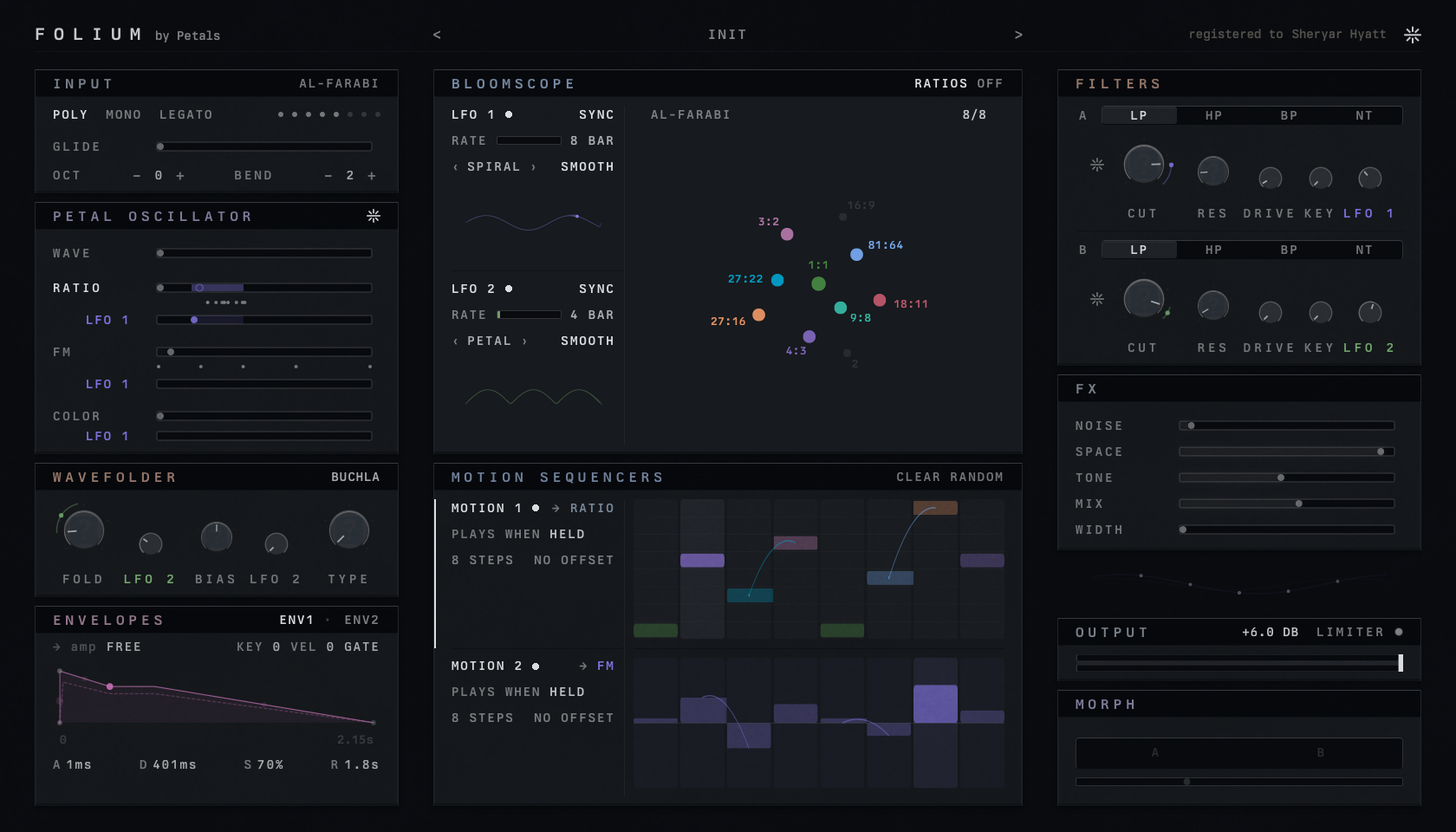
Play your scale as FM ratios.
Your scale's intervals become the Petal Oscillator's ratios. 3:2 rings like a bell, 16:9 turns metallic.
Morph between two entire patches.
Set State A, change anything, set State B, and the crossfader runs between them.
Dial your sound in with lovingly tuned filters.
Two filters per voice, locked to your scale so the cutoff lands on partials that belong to it.
Shape the envelope right on the line.
Drag a node to set its time and level. ENV 1 shapes loudness, ENV 2 goes wherever you point it.
Explore your scales visually.
Every interval in your scale is a dot. Click up to eight and they become the ratio slider's steps.
Quickly program interesting modulation patterns.
Two lanes, eight steps. Draw a pattern and send it to the ratio, FM, fold, a cutoff or the morph fader.
Fold waves until they sing.
Fold, bias, and a continuous morph between Buchla, Serge and Lockhart curves.
Give every voice its own reverb tail.
Noise, space, tone, mix, width. Five sliders, top to bottom.
The spec sheet
- Engine
- FM synthesis (phase modulation) + wavefolding
- Voices
- 8-voice, independent filters & FDN reverb per voice
- Oscillator
- Ratios locked to the loaded scale, accurate to under a cent, measured, not assumed, including scales that never repeat at the octave. Three carrier waves: Sine, Warp, and a Scale-Derived carrier rebuilt from the scale's degrees.
- Wavefolder
- Fold 1-8, bipolar bias, continuous morph across the Buchla, Serge, and Lockhart curves.
- Filters
- Dual series per voice, four modes each. Scale-lock quantization pins the cutoff to in-scale partials of the played note, and past 70% resonance it self-oscillates on them.
- Envelopes
- 2× DAHDSR on a shared line. Per-stage curves, per-stage DAW sync, Gate / One-Shot / Loop.
- Modulation
- Seven routable destinations, each with a switchable source. 2 LFOs, ten shapes each, plus both envelopes. Pre-routed at the factory. Plus 2 Motion Sequencer lanes with TB-303 glides.
- Reverb
- An 8-line modulated FDN reverb, per voice.
- Microtuning
- MTS-ESP and Scala (.scl). A patch embeds its tuning.
- Formats
- VST3 and CLAP plugin, Mac (Apple Silicon & Intel)
Folium.
In Early Access for Mac - VST3 and CLAP.
Payments by Stripe.